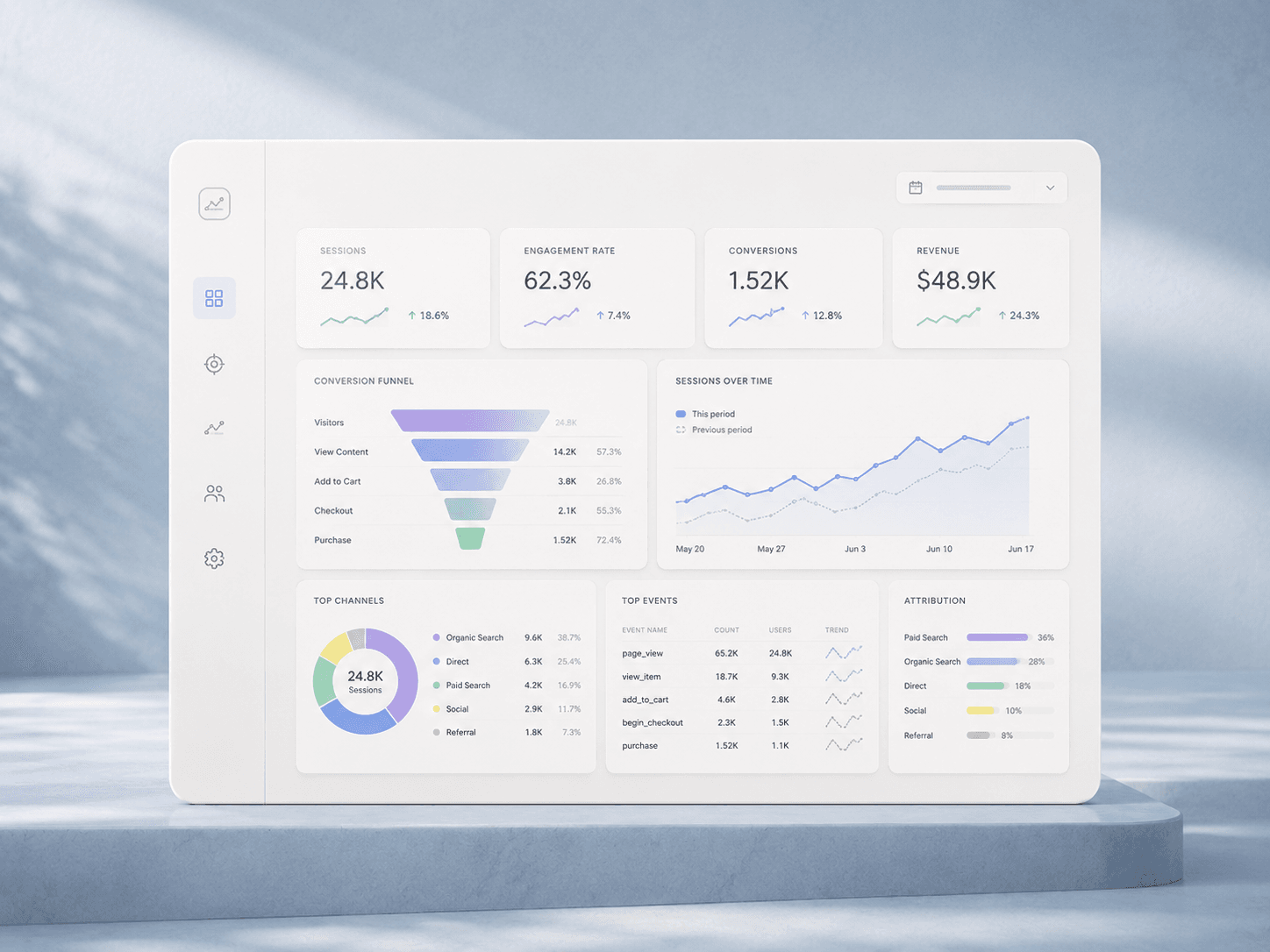
Core Web Vitals and Rankings
LCPINPCLSSEO
For websites whose LCP, INP or CLS weaken user experience and the technical SEO foundation. Core Web Vitals do not replace relevance or content, but they can support or hold back visibility noticeably.
Website Performance
From Berlin.
We analyze and optimize the performance of websites and shops so loading speed, user experience and visibility noticeably improve. We do not look at isolated metrics alone, but at how server, code, CMS, design, content and third-party services work together - then optimize where the biggest lever for users, search engines and conversion lies.
Website performance shapes how users perceive a company, whether content is read and whether interest becomes an inquiry or a purchase. A website that takes three seconds to load can lose more than half of its mobile visitors - and with them visibility, trust and business. Google uses Core Web Vitals in its ranking systems, users read speed as a quality signal and shops can measure the link between loading time and revenue directly.
For us, performance optimization is part of a broader view of the web project. Hosting, server response times, frontend code, CMS configuration, images, fonts, third-party scripts and the relationship between design and content all decide how quickly a website arrives for the user. We understand these dependencies, analyze the causes and optimize with the ambition that a faster website is also a better website - for users, for search engines and for the business.
Performance optimization helps websites and shops load faster, strengthen their technical SEO foundation, build more trust and turn visitors into customers more effectively.
For websites whose LCP, INP or CLS weaken user experience and the technical SEO foundation. Core Web Vitals do not replace relevance or content, but they can support or hold back visibility noticeably.
For online shops where loading time on product pages, category pages and checkout visibly affects conversion. Every delay in the purchase path lowers the likelihood that visitors complete the order.
For WordPress websites and WooCommerce shops that have become slower over time because of plugin overload, uncontrolled scripts, outdated themes, missing caching strategy or weak hosting configuration.
For websites that load much slower on smartphones and tablets than on desktop. More than half of traffic is often mobile today, and mobile users have little patience for slow pages.
For projects where performance should be planned as a quality standard from the beginning across architecture, hosting, frontend and CMS.
For websites and shops that should stay fast after optimization, even when content, plugins, tracking scripts and new features are added.
Website performance is not one lever. It is the result of many factors working together. Compressing images alone rarely solves the real problem. We analyze every layer and optimize where the effect is strongest.
Server response time determines how quickly a website can even begin to load. Slow servers, wrong PHP versions, missing caching and poorly configured hosting environments hold back every frontend optimization. Time to First Byte is the foundation everything else builds on.
Too much CSS, too much JavaScript, uncompressed assets, missing prioritization of the critical rendering path and fonts that block rendering all influence how quickly the page appears visually and responds to interaction.
Uncompressed images, wrong formats, missing responsive variants and images loaded before they are visible are among the most common causes of slow loading. Modern formats such as WebP and AVIF, lazy loading and correct sizing make a substantial difference.
Every plugin can load its own scripts, stylesheets and database queries. Too many plugins, outdated themes, heavy page builders and poor database maintenance make websites slower over time, often gradually and unnoticed. WordPress and WooCommerce are especially exposed to this effect.
Tracking, chat widgets, marketing pixels, external fonts and social embeds load their scripts independently from the website itself. Every script costs loading time and can weaken Core Web Vitals when it blocks rendering or causes layout shifts.
Google evaluates page experience through three core metrics: LCP measures how quickly the largest visible element appears, INP measures how quickly the page reacts to input and CLS measures how stable the layout remains while loading. Good values improve user experience and support search performance.
We analyze, optimize and monitor website and shop performance with the ambition that every measure creates a measurable difference for loading speed, user experience and visibility.
We measure loading speed, Core Web Vitals, server response times, rendering behavior, asset sizes, database queries, plugin load and third-party scripts. This creates a clear picture of what slows the website down, which factors interact and which measures have the strongest effect - prioritized by impact and effort.
CSS, JavaScript, fonts, critical rendering paths, lazy loading and preloading are optimized so the website appears quickly, reacts to interaction and does not waste resources. Where needed, scripts are cleaned up, combined or loaded asynchronously without breaking existing functionality.
Images are converted to modern formats, resized to the dimensions actually needed, given responsive variants and only loaded when they enter the viewport. For shops and image-heavy websites, this often creates the largest improvement in loading speed.
Server configuration, PHP versions, database tuning, object caching, page caching, CDN integration and hosting environment are set up so response times stay low and the website remains fast under load. If the current hosting limits performance, we advise on migration.
Plugin audits, theme cleanup, database optimization, caching strategy and code quality are improved deliberately. In WordPress and WooCommerce, we know the typical causes - too many plugins, uncontrolled scripts, heavy page builders, missing caching setup - and address them at the root.
LCP, INP and CLS are improved so user experience, technical quality and SEO foundations work together. The work is implemented so design, user guidance and functionality remain intact. A website that loads fast but looks worse or can do less solves the wrong problem.
After optimization, we monitor performance values, Core Web Vitals and server behavior, identify setbacks early and act before new content, plugins, tracking scripts or features slow the website down again.
Performance optimization becomes effective when it improves more than scores and understands the interaction between technology, design, content and operations. This is where we combine technical depth with a view of the full project.
We do not optimize single metrics in isolation. We understand how hosting, code, CMS, design, content and third-party services interact. From that comes a prioritized plan that starts where loading speed, rankings and conversion gain the most.
Most WordPress performance problems come from plugin overload, theme legacy, missing caching strategy and uncontrolled scripts. We know these causes from years of work on demanding WordPress projects and solve them at the root.
We optimize performance with the sensitivity needed to preserve design, imagery, motion and interaction quality. Fast websites and high-quality design are not opposites when they are planned together.
We measure before, optimize deliberately and measure after. Every measure has a clear goal and visible effect. Results are documented so business, marketing and IT understand what changed and why.
Performance is not a one-time project. It is a quality standard that needs attention. We stay available for monitoring, new requirements and the question of how the website stays fast as content, features and tracking grow.
When loading time, PageSpeed score or Core Web Vitals are not where they should be, a close look at causes and levers is worthwhile. We analyze what slows the website down and show which measures make the biggest difference.
Request a Performance AnalysisFast websites come from the interaction of hosting, technical care, clean development and an understanding of what matters in ongoing operation.
High-performance hosting for websites with powerful servers, monitoring, German infrastructure and a foundation for fast loading times.
Faster websites keep visitors longer, strengthen trust in the brand and convert better. Google uses Core Web Vitals in its ranking systems, and studies show that longer loading times can noticeably affect conversion and revenue. For shops, that means direct revenue impact; for company websites, fewer inquiries.
Core Web Vitals are Google's metrics for website user experience. LCP measures how quickly the main visible content appears, INP measures responsiveness during interaction and CLS measures visual stability while loading. Good values do not guarantee rankings, but they are an important quality foundation for users, search engines and every other SEO measure.
Good Core Web Vitals are a useful technical orientation: important content should become visible quickly, interactions should respond without noticeable delay and the layout should remain stable. The real question is how fast actual users experience the site on their devices. Every meaningful improvement supports user experience, trust, conversion and the foundation for visibility.
The most important factors are server response time and hosting quality, frontend code such as CSS, JavaScript and fonts, image sizes and formats, CMS and plugin configuration, third-party scripts such as tracking or chat widgets, caching strategy and CDN integration. In practice, these factors interact. That is why we analyze how they work together instead of optimizing isolated levers.
It starts with an audit. We measure loading time, Core Web Vitals, server response times, asset sizes, plugin load and third-party scripts and identify the causes. From there, we create a prioritized action plan. Optimization is implemented step by step and measured after each relevant change so the effect remains understandable. After completion, we can provide ongoing monitoring.
That depends on the starting point, technical basis and goal. A clearly defined frontend issue is different from a project involving hosting, WordPress or WooCommerce audit, image library, third-party scripts and ongoing monitoring. We first identify what is actually slowing the site down and which measures will have the strongest effect.
WordPress and WooCommerce are core areas for us. We know the typical performance problems: plugin overload, uncontrolled scripts, heavy page builders, outdated themes, missing caching strategy and slow database queries. We address them deliberately at the root.
Our standard is that design and speed work together. We optimize images, fonts, motion and scripts so visual quality remains and the website still loads much faster. A faster website that looks worse solves the wrong problem. That is why design understanding and technical optimization belong in the same process for us.
Google uses Core Web Vitals and page experience in its ranking systems, but good metrics do not replace relevance, content or a clean site architecture. Performance strengthens the technical foundation: pages become easier to use, crawling and user experience improve, and other SEO work can perform on a stronger base.
That depends on how new content, plugins, tracking scripts and features are handled. Every new plugin, additional script and uncompressed image can make loading time worse again. We offer ongoing performance monitoring and intervene before new additions undo the optimization.
The PageSpeed score in Google PageSpeed Insights is a synthetic assessment based on simulated tests. It gives useful orientation, but does not always reflect the real user experience. Actual Core Web Vitals are measured from real users and represented in Google's CrUX data. We work with both perspectives: lab tests for diagnosis and field data to understand how the website performs for real visitors.
If your website should load faster, become more visible and build more trust, let us talk about the current state, metrics and measures that make the biggest difference for users, search engines and conversion.
Discuss PerformanceBxW Agency
Wir nutzen notwendige Cookies für den Betrieb der Website. Google Analytics laden wir erst, wenn Sie zustimmen.